Three-Phase PM Motor Scenario
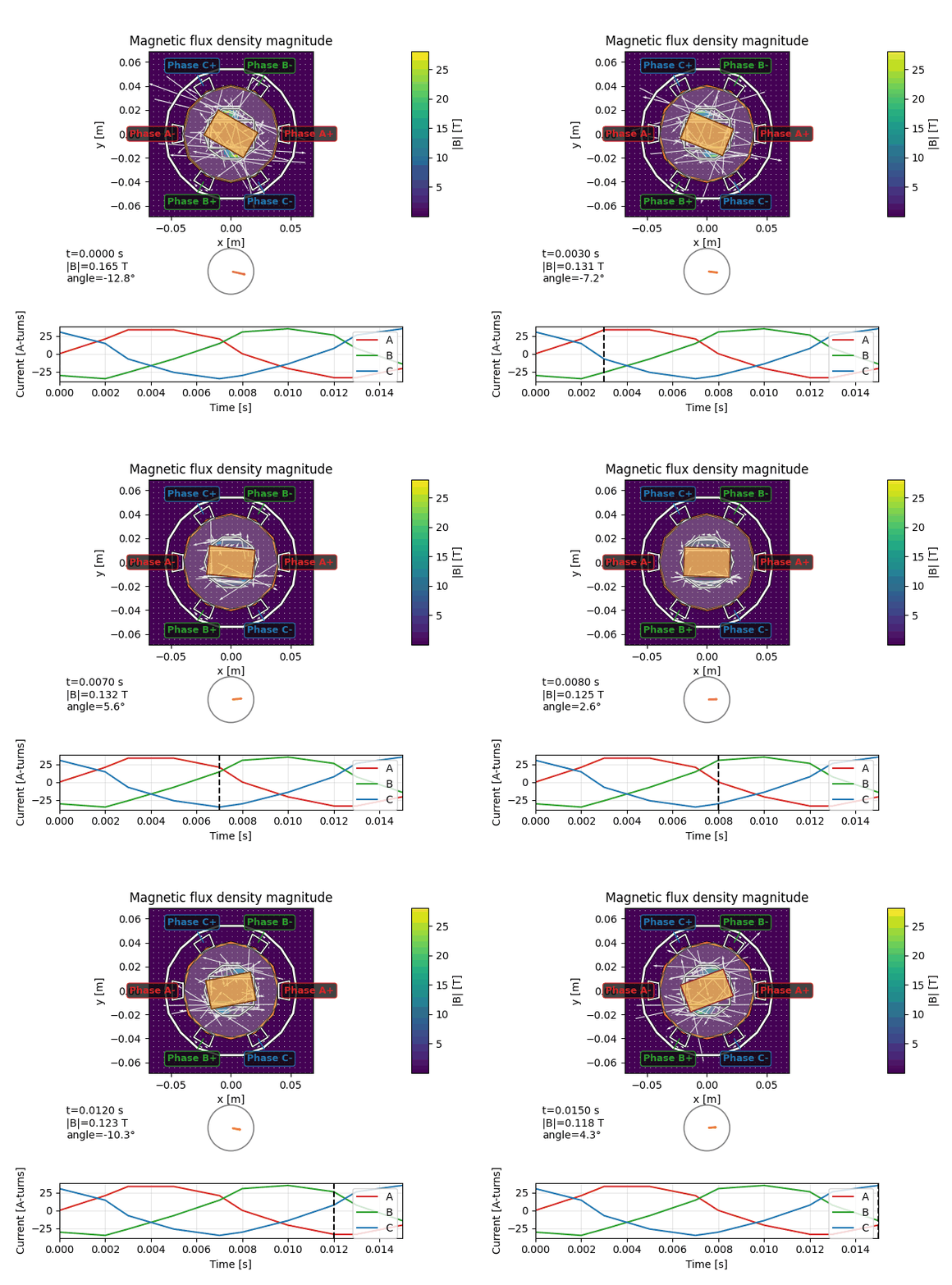
This walkthrough builds on the rotating-field stator demo by adding a surface-mounted permanent-magnet rotor (trimmed to 1×10⁵ A/m with μᵣ≈1.05), per-phase RL circuits, and a lightweight mechanical model driven by 35 A peak stator currents. Use it to explore torque production, back-EMF, and circuit response in a synchronous motor setting. The generator now supports both a locked-rotor mode (matching earlier releases) and a spin-up mode that lets the mechanical integrator advance the rotor angle from the electromagnetic torque.
Quickstart (locked rotor)
python3 python/gen_three_phase_pm_motor.py --profile ci --mode locked --out inputs/three_phase_pm_motor_ci.json
./build/motor_sim --scenario inputs/three_phase_pm_motor_ci.json --solve --vtk-series outputs/pm_motor_ci.pvd --tol 5e-6 --max-iters 40000
python3 python/animate_three_phase.py --pvd outputs/pm_motor_ci.pvd --scenario inputs/three_phase_pm_motor_ci.json --save pm_motor_demo.mp4 --frame-png pm_motor_demo.png
The locked mode emits the same deterministic timeline used in earlier demos: it
drives sinusoidal phase voltages, integrates coil currents via the circuit
solver, and keeps the rotor phased to the stator field via explicit
rotor_angles entries.
Spin-up mode
python3 python/gen_three_phase_pm_motor.py --profile ci --mode spinup --out inputs/three_phase_pm_motor_spinup_ci.json
./build/motor_sim --scenario inputs/three_phase_pm_motor_spinup_ci.json --solve --vtk-series outputs/pm_motor_spinup_ci.pvd --tol 5e-6 --max-iters 40000
python3 python/check_pm_spinup.py --mechanical outputs/pm_motor_spinup_mechanical.csv --scenario inputs/three_phase_pm_motor_spinup_ci.json
python3 python/animate_three_phase.py --pvd outputs/pm_motor_spinup_ci.pvd --scenario inputs/three_phase_pm_motor_spinup_ci.json --save pm_motor_spinup.mp4 --frame-png pm_motor_spinup.png
Spin-up removes the timeline rotor overrides so the RK4 mechanical integrator
advances the rotor based on the torque probe feedback. The generator also emits
pm_motor_spinup_mechanical.csv, a rotor angle/speed log that the
python/check_pm_spinup.py helper validates for monotonic acceleration.
Profiles
python/gen_three_phase_pm_motor.py exposes the same ci and hires presets as
the stator generator. Use --mode locked (default) for the deterministic rotor
timeline or --mode spinup to enable mechanical integration. All profiles accept
--cycles and --frames-per-cycle overrides when you need shorter or longer
timelines:
ci: 65×65 grid, 12 frames (one electrical cycle)hires: 401×401 grid, 120 frames per cycle, three electrical cycles
Pass --profile hires to emit the larger dataset. All downstream commands stay
the same.
Scenario highlights
- Rotor assembly – A rigid body named
pm_rotorgroups the rotor iron polygon and the rectangular magnet block. The generator also carves the magnet out of the rotor iron and assigns it thepm_magnetmaterial (μᵣ≈1.05) so the magnetisation vector does not experience an 800× permeability boost. Locked mode includes"rotor_angles"timeline entries to phase-lock the magnet to the rotating stator field by a configurable load angle, while spin-up mode omits them so the mechanical integrator owns the pose. - Circuits – The
stator_three_phasenetwork models each phase as a seriesR-Lbranch with a driven voltage source. Coil links bind both slot polygons for a phase to the shared inductor so the circuit solver injects equal and opposite current densities. The ingestor now enforces that each coil link’s turn count matches the associatedcurrent_region, keeping the magnetic ampere-turn budget consistent between the field solve and the circuit model. - Slot packing – Slot polygons carry 60 turns apiece with a 0.55 fill fraction. The rasteriser multiplies the timeline or circuit current by both factors so the resulting ampere-turn budget matches what the circuit solver assumes when computing coil flux linkages.
- Bore field levels – The pm-magnet material keeps |B| in the rotor block on roughly the same sub-tesla scale as the driven stator coils rather than the 50–200 T range seen when the magnet inherited the 800× permeability of the surrounding steel. This makes the torque interaction easier to inspect and maintains a realistic magnitude for induced voltages.
- Mechanical coupling – The
mechanicalsection specifies rotor inertia, viscous damping, constant load torque, and the torque probe that feeds the integrator. Spin-up mode keeps the timeline free of overrides so the solver performs an RK4 update after each frame to evolve angle and speed. - Probes – Back-EMF loops measure the induced voltage inside every positive slot, while the torque probe wraps a circular loop just outside the rotor to collect Maxwell stress and co-energy samples.
Outputs
- Locked mode uses the
pm_motor_*.csv/.vti/.pvdnaming scheme. Spin-up mode mirrors the same exports with apm_motor_spinup_*prefix and addspm_motor_spinup_mechanical.csvcapturing time, angle, speed, and torque for each rotor sample. - Torque CSVs now aggregate timeline samples at the base path (for example
pm_motor_spinup_torque.csv). Each row recordstime_s,frame_index,Fx,Fy,Tzand, when available,CoEnergy, so finite-difference virtual-work checks can be run directly against the solved timeline without chasing individual_frame_###files. - Both modes emit a
circuit_traceCSV (pm_motor_currents.csvorpm_motor_spinup_currents.csv) listing per-coil ampere-turn histories. The file feeds thepython/generate_rotor_animation.pyhelper so slot colours in the rotor-only GIFs reflect the solved coil currents.
CI spin-up fixture at a glance
The regression stored at inputs/tests/pm_motor_spinup_test.json is generated
verbatim from:
python3 python/gen_three_phase_pm_motor.py --profile ci --mode spinup \
  --out inputs/tests/pm_motor_spinup_test.json
The JSON clocks in at roughly 1.3k lines—the generator rounds coordinates to three decimal places for the CI profile and keeps each circular boundary to a few dozen segments (18 for the stator, 12 for the bore, 10 for the rotor, 24 for the torque loop). The timeline spans a single electrical cycle (10 frames) so the mechanical solver still sees enough motion to verify acceleration. Key baked-in values for the CI fixture are:
| Quantity | Value |
|---|---|
| Grid | 65×65 Cartesian cells over a 0.14 m square |
| Electrical frequency | 60 Hz (10 frames per cycle, 1 cycle) |
| Rotor inertia / damping | 8.0×10⁻⁴ kg·m², 5.0×10⁻⁵ N·m·s |
| Load torque | 0.12 N·m opposing rotation |
| Magnet strength | 1×10⁵ A/m surface-mounted block |
| Slot turns / fill | 60 turns per slot, 0.55 copper fill fraction |
| Phase drive | 35 A peak warm-start currents with 20 V peak phase voltage |
Rather than editing the JSON manually, re-run the generator when you need to tweak those knobs so the derived polygons stay consistent.
Faster local experiments
The bundled test still takes roughly a minute on two vCPUs so the torque and mechanical traces match the CI artefacts while remaining tractable. For day-to-day iteration you can emit smaller timelines without touching the committed fixture. A few useful variants:
# Half a cycle on the CI grid (6 frames) for quick smoke checks
python3 python/gen_three_phase_pm_motor.py --profile ci --mode spinup \
  --frames-per-cycle 6 --cycles 1 --out scratch/spinup_quick.json

# Coarser mechanical sampling on a reduced grid
python3 python/gen_three_phase_pm_motor.py --profile ci --mode spinup \
  --cycles 1 --frames-per-cycle 8 --out scratch/spinup_57.json

# Re-run only the spin-up regression once you have a new fixture
ctest --test-dir build --output-on-failure -R pm_motor_spinup
Keep the official regression JSON in place so GitHub Actions exercises the full solve, but feel free to adjust the generator overrides locally when validating mechanical changes or iterating on torque probes.
Tips
- Run
python/check_three_phase_field.pyagainst the generated.pvdto verify the bore angle rotates monotonically and maintains a strong |B| magnitude. - Use
python/check_pm_spinup.pyon spin-up runs to assert that rotor angle and speed change monotonically in magnitude throughout the timeline (the helper reports absolute angle/speed gains, so it also tolerates rotors that spin in the negative direction as in the induction demo). - The mechanical integrator respects timeline rotor overrides; locked mode retains them while spin-up drops them so the solver can demonstrate the coupled evolution.
- Pair the torque CSV with the co-energy column to compute finite-difference virtual-work torque checks over neighbouring frames.
- Keep generated VTK/MP4 artefacts out of the repository. CI uploads small samples for review when the workflow executes the PM motor pipeline.
- Looking for a transient induction counterpart? See
docs/three_phase_induction_motor.mdfor the conductive-bar spin-up workflow.