Radar Cross Section
Simulations with openEMS
Spatial backscatter attribution for arbitrary geometries — mapping which geometric features actually dominate radar observability using open-source FDTD field simulation.
Engine cavities — not leading edges or wing tips — are the dominant backscatter contributors in the simulated UAV geometry. The most visually prominent features are not always the most radar-significant ones.
The CUDA/openEMS follow-on found that accelerating the core FDTD kernels is not enough: large-grid performance is limited by openEMS' CPU-oriented extension and probe interface. Read the GPU report.
Full-Wave FDTD
openEMS-based simulation captures all scattering mechanisms: resonances, cavity effects, diffraction, and surface currents — no physical optics approximations.
Spatial Attribution
Directional Poynting vector accumulation produces hot-spot maps showing which geometric features contribute most to backscatter, without full ISAR reconstruction.
Open Source
All simulation scripts, geometry files, and analysis tools are freely available. No commercial EM solver license required.
Capability Maturity Model
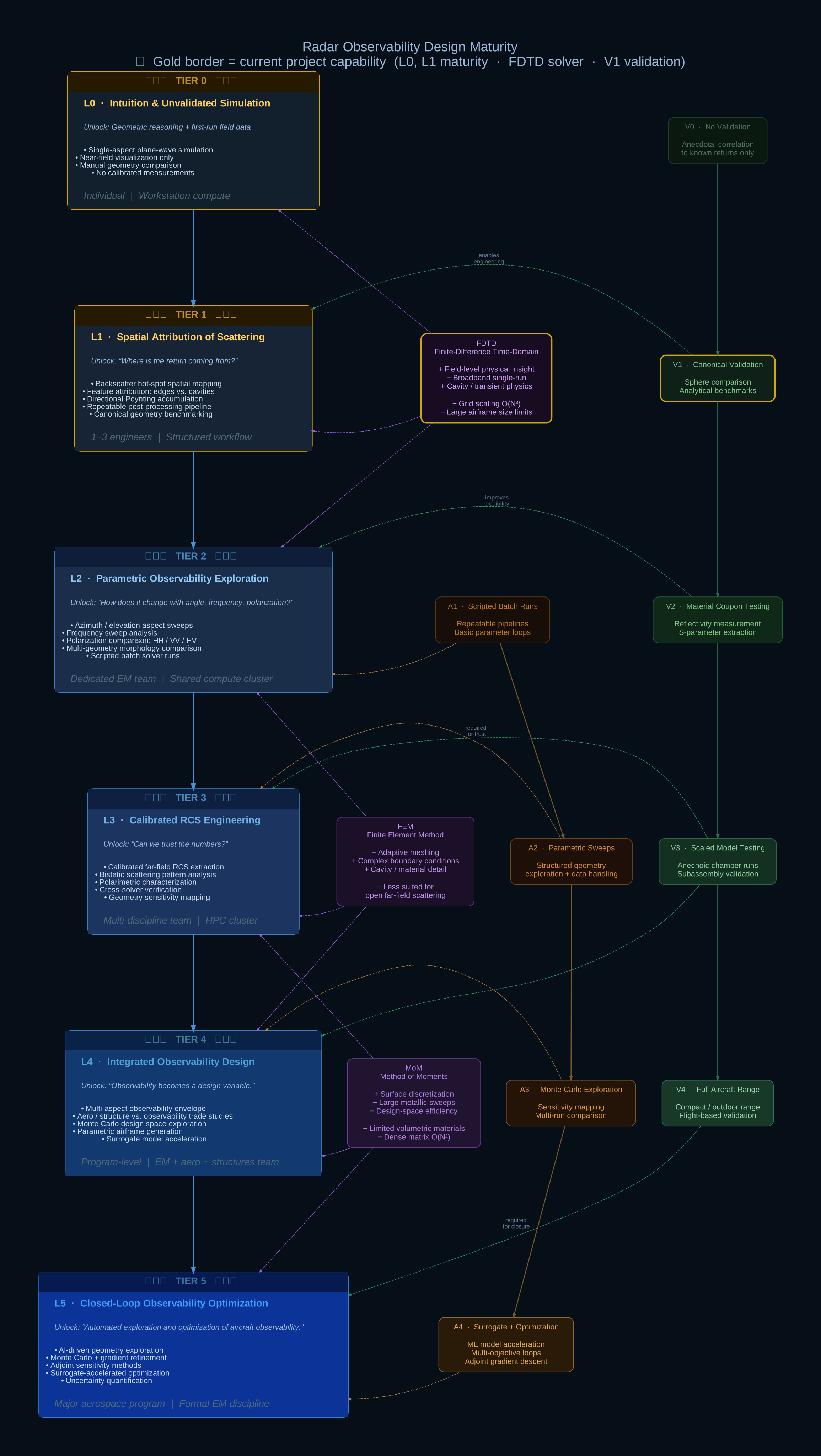
RCS simulation capability spans maturity levels from intuition-based reasoning (L0) through closed-loop computational optimization (L5). This project demonstrates L1: spatial backscatter attribution with canonical validation.
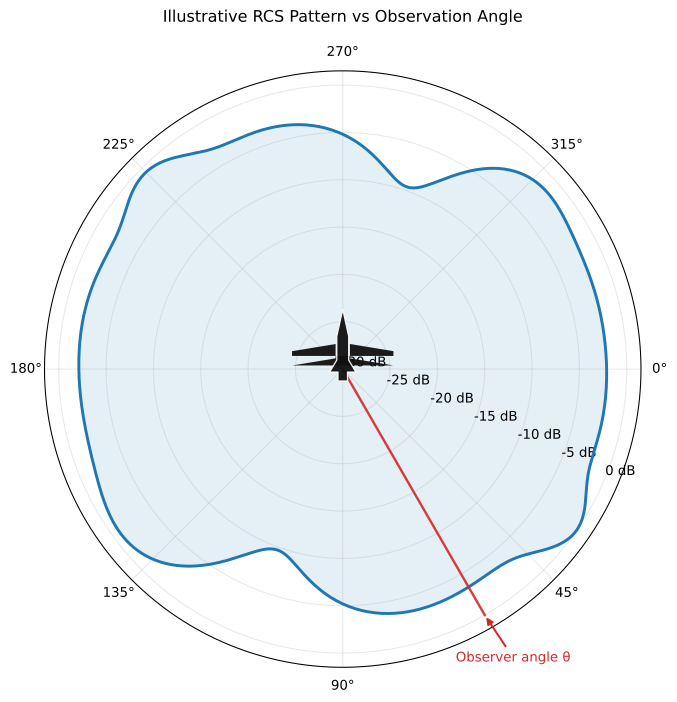
RCS as a Spatial Distribution
Radar cross section is not a scalar value — it varies with aspect angle, frequency, polarization, and target orientation. Treating it as a single number collapses the spatial information needed to understand which features dominate.